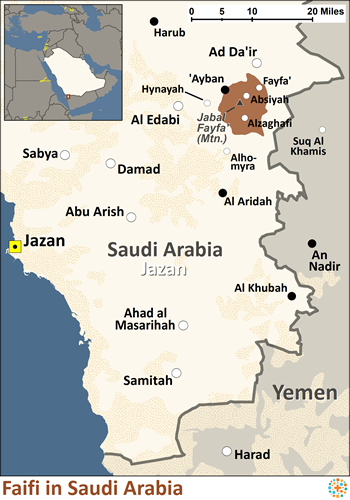

The Faifi are an indigenous mountain people living primarily in the Jabal Fayfa region of Jazan Province in southwestern Saudi Arabia near the border with Yemen. Their identity is closely tied to the Faifi language, also called Khawlaniyah or Fayfiya, a rare and highly distinctive Semitic language spoken in the isolated mountain region for centuries. Linguists debate whether Faifi is an unusual Arabic dialect or a surviving descendant of ancient South Arabian languages once widespread across southern Arabia. Because of its ancient features and geographic isolation, the language has drawn increasing scholarly attention in recent years.
Historically, the mountainous terrain of Jabal Fayfa allowed the Faifi people to maintain a significant degree of independence and cultural preservation. Until modern roads were built in the late twentieth century, many villages remained difficult to access, helping preserve both the language and older social customs. The Faifi are connected to the broader Khawlan tribal heritage that extends into neighboring Yemen, and tribal identity remains important within community life.
Modernization, migration, education, and mass media have increasingly affected the Faifi community. Younger generations often leave the mountain region for employment or study in larger Saudi cities, and many shift toward dominant Arabic dialects and Modern Standard Arabic. As a result, scholars now consider Faifi an endangered language. Older generations tend to preserve the strongest command of the traditional speech, while younger speakers increasingly use mainstream Saudi Arabic forms in daily life.
The Faifi traditionally live in steep mountain villages where agriculture shaped daily life for generations. Terraced farming remains one of the defining features of the region, with families cultivating crops suited to the mountainous climate, including coffee, millet, corn, fruits, vegetables, and qat in some areas. The rugged geography required careful management of land and water resources, and many villages developed tightly connected social structures built around cooperation and family ties.
Homes in Jabal Fayfa are often built on mountain slopes using stone and local materials adapted to the terrain. Extended family relationships and tribal affiliation remain highly important within the community. Hospitality, respect for elders, and preservation of family honor are strongly valued cultural traits. Oral poetry, storytelling, and local dialect traditions continue to play an important role in preserving Faifi identity.
Because the region remained geographically isolated for much of its history, many traditional customs survived longer than in other parts of Saudi Arabia. However, modernization has rapidly changed village life. Roads, education, mobile technology, and migration have increased contact with mainstream Saudi society. Younger generations often pursue work and education outside the mountains, contributing to declining use of the Faifi language and gradual cultural change.
Despite modernization, many Faifi families still maintain strong attachment to their ancestral mountain homeland. Agricultural work, local markets, tribal gatherings, and religious festivals continue to shape community life in the region.
The Faifi are Sunni Muslims, and Islam strongly shapes their personal, family, and community life. Religious practices commonly include daily prayer, fasting during Ramadan, mosque participation, and observance of Islamic customs connected to marriage, burial, and family celebrations. Saudi Arabia as a whole is deeply shaped by conservative Sunni Islamic identity, and the Faifi are generally considered especially conservative in religious outlook.
At the same time, older tribal customs and traditional beliefs continue to influence aspects of life within some communities. In isolated mountain societies, beliefs involving blessings, curses, protection from evil influences, or supernatural harm may exist alongside formal Islamic practice. Tribal identity and religion are often closely intertwined within family and village life.
Very few Faifi have had meaningful exposure to biblical Christianity. Christianity is often viewed as foreign and outside acceptable community life in Saudi Arabia. Social pressure, religious conservatism, and legal restrictions make open Christian witness extremely difficult. The Faifi need to hear clearly that forgiveness of sins and reconciliation with God come through Jesus Christ alone rather than through religious identity, ritual observance, or human effort.
The Faifi need greater access to the gospel through culturally sensitive and long-term Christian witness. Their strong Islamic identity, geographic history of isolation, and social conservatism create major barriers to evangelism. Very few known believers exist among them, and there are limited Christian resources available specifically in the Faifi language.
Language preservation is also an important issue. Researchers increasingly describe Faifi as endangered because younger generations often shift toward mainstream Arabic varieties. The loss of the language would also mean the loss of a unique cultural and historical heritage tied to the mountains of southwestern Arabia.
Practical needs include economic opportunity for younger generations, sustainable development in rural mountain communities, and preservation of local cultural identity amid rapid modernization. While infrastructure has improved greatly in recent decades, migration and outside cultural influence continue to reshape traditional community life.
The Faifi need Scripture resources, discipleship materials, and gospel teaching communicated in culturally understandable ways. Audio Scripture and relational ministry may be especially important because of the oral and family-centered nature of the culture. Any believers among them would need encouragement, biblical training, wisdom, and discreet fellowship support because of social pressure surrounding conversion to Christianity.
Pray that the Faifi people will hear a clear presentation of the gospel and place their faith in Jesus Christ for salvation.
Pray that God will raise up faithful Christian workers who are willing to serve among the Faifi with wisdom, humility, and perseverance despite strong social and religious barriers.
Pray that the Faifi people will be adopted through the People Group Adoption program so that churches and believers will commit to sustained prayer and future gospel outreach among them.
Pray that any believers among the Faifi will grow strong in biblical truth and boldly but wisely share the hope of Christ with their families and communities.
Scripture Prayers for the Faifi in Saudi Arabia.
https://en.wikipedia.org/wiki/Faifi_language
https://fr.wikipedia.org/wiki/Faifi
https://www.nature.com/articles/s41599-024-03887-5
https://scholarspace.manoa.hawaii.edu/items/59979cd6-143c-4dc0-9362-de91254522f1
https://journals.sagepub.com/doi/pdf/10.1177/21582440241255865
https://www.openbookpublishers.com/books/10.11647/obp.0411/chapters/10.11647/obp.0411.05
| Profile Source: Joshua Project |